








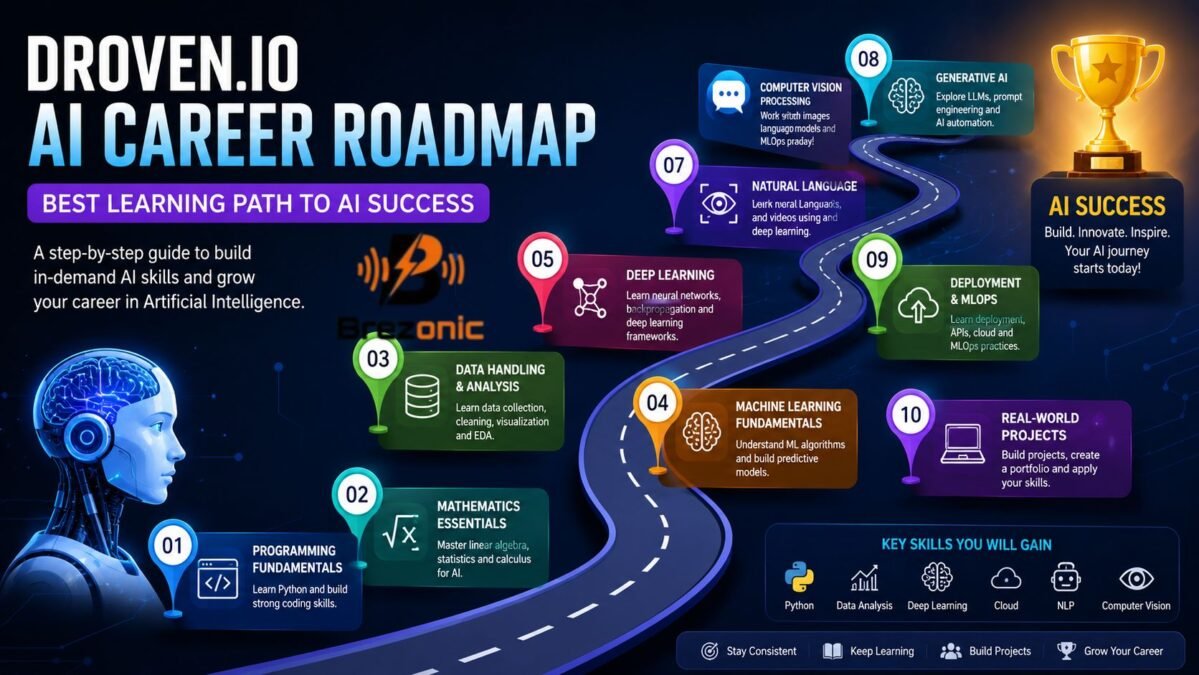
Droven.io AI Career Roadmap Artificial Intelligence (AI) is transforming industries faster than almost any other technology in history. From healthcare and finance to education, manufacturing, and entertainment, AI-powered solutions are changing how businesses operate and how people work. As demand for AI professionals continues to rise, many aspiring learners are asking the same question: What is the best learning path to build a successful AI career?
The Droven.io AI Career Roadmap offers a structured approach that helps beginners, students, and professionals understand the essential skills needed to thrive in this rapidly growing field. Instead of trying to learn everything at once, a roadmap provides a step-by-step journey that builds strong foundations before moving into advanced concepts.
Quick Bio
| Information | Details |
|---|---|
| Topic | Droven.io AI Career Roadmap |
| Category | Artificial Intelligence & Career Development |
| Purpose | Provides a structured learning path for building AI skills and advancing an AI career. |
| Target Audience | Students, beginners, developers, IT professionals, and career changers interested in AI. |
| Core Skills Covered | Python, Mathematics, Machine Learning, Deep Learning, NLP, Computer Vision, MLOps, and Cloud Computing. |
| Career Goal | Prepare learners for AI-related job roles through practical learning and hands-on projects. |
| Additional Information | Details |
|---|---|
| Learning Level | Beginner to Advanced |
| Recommended Project Type | Real-world AI applications, predictive models, chatbots, recommendation systems, and image recognition projects. |
| Portfolio Importance | Demonstrates practical skills and increases employability in AI-related roles. |
| Key Career Roles | AI Engineer, Machine Learning Engineer, Data Scientist, NLP Engineer, Computer Vision Engineer, and MLOps Engineer. |
| Learning Approach | Step-by-step roadmap combining theory, coding practice, and project-based learning. |
| Main Objective | Help learners develop industry-ready AI skills and build a successful long-term career in artificial intelligence. |
Why AI Is One of the Best Career Choices Today
Artificial Intelligence is no longer limited to research laboratories. Companies of every size now use AI to automate tasks, improve customer experiences, analyze massive datasets, and make smarter business decisions.
The increasing adoption of AI has created strong demand for professionals such as:
- AI Engineers
- Machine Learning Engineers
- Data Scientists
- Computer Vision Specialists
- NLP Engineers
- Robotics Engineers
- AI Product Managers
- AI Researchers
- Prompt Engineers
- AI Consultants
Because AI continues expanding into new industries, skilled professionals often enjoy excellent salaries, diverse career opportunities, and continuous learning.
Build Strong Programming Skills
Programming is the foundation of every AI career.
Although multiple programming languages are used in AI development, Python remains the most popular because of its simplicity and extensive ecosystem.
Begin by learning:
- Variables
- Loops
- Functions
- Classes and objects
- File handling
- Error handling
- Modules and packages
Once comfortable with Python, practice solving coding challenges to strengthen logical thinking and problem-solving skills.
Writing clean, readable, and efficient code becomes increasingly important as projects grow more complex.
Learn Mathematics Behind AI
Many beginners skip mathematics because it appears difficult, but understanding mathematical concepts greatly improves your ability to build and optimize AI models.
Important topics include:
Linear Algebra
Learn concepts like:
- Vectors
- Matrices
- Matrix multiplication
- Eigenvalues
- Eigenvectors
These concepts power many machine learning algorithms.
Probability and Statistics
Statistics helps AI systems make predictions based on data.
Focus on:
- Mean
- Median
- Variance
- Standard deviation
- Probability distributions
- Bayes theorem
Calculus
Machine learning models rely on optimization techniques that use calculus.
Important concepts include:
- Derivatives
- Partial derivatives
- Gradient descent
You do not need to become a mathematician, but understanding these fundamentals makes advanced AI much easier.
Master Data Handling
Data is the fuel that powers artificial intelligence.
AI professionals spend significant time collecting, cleaning, transforming, and analyzing datasets.
Essential skills include:
- Data preprocessing
- Missing value handling
- Feature engineering
- Data visualization
- Exploratory Data Analysis (EDA)
Popular Python libraries include:
- NumPy
- Pandas
- Matplotlib
- Plotly
- Scikit-learn
Learning how to work with real-world datasets prepares you for professional AI projects.
Understand Machine Learning Fundamentals
Machine Learning is the core of modern AI.
Start with supervised learning before exploring more advanced topics.
Important algorithms include:
Regression
Used for predicting continuous values such as prices or temperatures.
Classification
Used to categorize information, such as spam email detection or disease diagnosis.
Clustering
Groups similar data without predefined labels.
Decision Trees
Simple yet powerful models used in many real-world applications.
Random Forest
An improved version of decision trees that increases prediction accuracy.
Support Vector Machines
Useful for classification tasks with complex decision boundaries.
Understand how each algorithm works, when to use it, and how to evaluate performance.
Learn Deep Learning
Deep Learning powers today’s most advanced AI systems.
It uses artificial neural networks that mimic how the human brain processes information.
Important concepts include:
- Neural Networks
- Activation Functions
- Forward Propagation
- Backpropagation
- Optimizers
- Loss Functions
Popular frameworks include:
- TensorFlow
- PyTorch
- Keras
Building neural networks from scratch helps develop a deeper understanding before using advanced frameworks.
Explore Computer Vision
Computer Vision enables machines to understand images and videos.
Applications include:
- Facial recognition
- Medical imaging
- Autonomous vehicles
- Industrial inspection
- Object detection
Skills to learn include:
- Image preprocessing
- Convolutional Neural Networks (CNNs)
- Image classification
- Object detection
- Image segmentation
Working on image recognition projects strengthens practical AI skills.
Learn Natural Language Processing (NLP)
NLP focuses on helping computers understand human language.
Modern AI assistants, chatbots, translation tools, and content generators all rely on NLP.
Important topics include:
- Text preprocessing
- Tokenization
- Word embeddings
- Sentiment analysis
- Language models
- Text classification
As generative AI continues evolving, NLP expertise has become one of the most valuable career skills.
Understand Generative AI
Generative AI is one of today’s fastest-growing technologies.
It powers tools capable of creating:
- Articles
- Images
- Videos
- Code
- Music
- Business reports
Key areas include:
- Large Language Models (LLMs)
- Prompt Engineering
- AI Agents
- Retrieval-Augmented Generation (RAG)
- Fine-tuning AI models
Professionals with generative AI skills are increasingly sought after across multiple industries.
Learn Cloud and Deployment
Building AI models is only part of the job.
Organizations need professionals who can deploy AI into production.
Useful skills include:
- Docker
- APIs
- Cloud computing
- Model deployment
- MLOps
- CI/CD pipelines
Popular cloud platforms include AWS, Microsoft Azure, and Google Cloud Platform.
Understanding deployment allows your AI solutions to operate in real-world environments.
Build Real AI Projects
Projects demonstrate your practical abilities far better than certificates alone.
Good beginner projects include:
- Movie recommendation system
- House price prediction
- Customer churn prediction
- Handwritten digit recognition
- Spam email detector
- AI chatbot
- Resume screening system
- Face mask detector
- Sales forecasting model
- Image classification application
Each project improves your portfolio while strengthening technical confidence.
Create an Impressive AI Portfolio
A strong portfolio helps employers evaluate your capabilities.
Include:
- Personal AI projects
- Git repositories
- Project documentation
- Screenshots
- Live demos
- Technical blogs
- Research summaries
Quality matters more than quantity. Even five excellent projects can significantly improve your chances of landing interviews.
Develop Soft Skills
Technical knowledge alone is not enough.
Successful AI professionals also develop:
- Communication
- Critical thinking
- Team collaboration
- Time management
- Presentation skills
- Business understanding
- Problem-solving
These skills become increasingly valuable as you progress into senior roles.
Stay Updated with AI Trends
Artificial Intelligence evolves rapidly.
Dedicate time every week to learning about:
- New AI frameworks
- Research papers
- Open-source projects
- Industry innovations
- Model improvements
- Emerging career opportunities
Continuous learning ensures your skills remain competitive.
Common Mistakes to Avoid
Many beginners slow their progress by making avoidable mistakes.
These include:
- Jumping directly into deep learning without learning machine learning basics
- Memorizing code instead of understanding concepts
- Ignoring mathematics
- Building only tutorial projects
- Avoiding real datasets
- Not practicing consistently
- Focusing solely on certificates
Building genuine skills produces far better career outcomes than collecting online certificates.
AI Career Opportunities
Following a structured roadmap opens doors to numerous professional roles.
Popular career paths include:
- Junior AI Engineer
- Machine Learning Engineer
- AI Software Developer
- Data Analyst
- Data Scientist
- NLP Engineer
- Computer Vision Engineer
- Research Scientist
- AI Consultant
- Robotics Engineer
- MLOps Engineer
- AI Solutions Architect
As experience grows, professionals often move into leadership, research, or specialized AI domains.
The Droven.io AI Career Roadmap is a structured learning guide that helps beginners and professionals understand the essential skills, tools, and technologies needed to build a successful career in artificial intelligence.
Yes. The roadmap starts with programming and mathematics fundamentals before progressing to machine learning, deep learning, and advanced AI concepts, making it ideal for beginners.
Python is widely considered the best programming language for AI because of its simplicity and the large number of AI and machine learning libraries available.
Final Thoughts
The Droven.io AI Career Roadmap provides a practical framework for anyone looking to enter the world of artificial intelligence with confidence. Rather than rushing through countless online courses, focus on mastering one skill at a time—starting with programming, mathematics, and data analysis before progressing to machine learning, deep learning, generative AI, and deployment.
Success in AI comes from consistent practice, curiosity, and solving real-world problems. Build meaningful projects, maintain a professional portfolio, strengthen both technical and soft skills, and embrace lifelong learning. By following a structured roadmap and staying committed to continuous improvement, you can develop the expertise needed to thrive in one of the most exciting and rewarding technology careers of the future.